On May 30th, 2009 I made the trip to Clarion, PA to see Henslow's Sparrows at the reclaimed strip mines at Piney Tract IBA, where I'd read there may be 100 pairs.
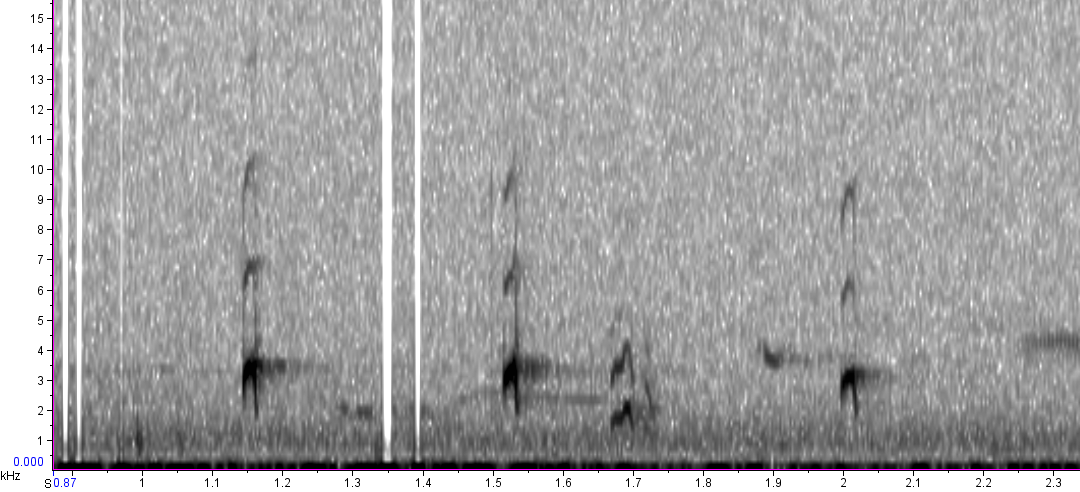
Henslow's Sparrows have a short, insect-like song that has been famously described as "one of the poorest of vocal efforts of any bird" by Roger Tory Peterson. Each male sings a single song that is made up of about five to seven notes. I recorded five different males; two had essentially identical songs, another two differed only by an extra introductory note by one of them, and the fifth had a very different song. So there were three distinctly different songs in a sample of five. These birds were recorded in the afternoon (Henslow's Sparrows also sing at night), and they mostly sang from the small bushes that dotted the grasslands:
Henslow's Sparrow breeding habitat at Piney Tract IBA
Note: when observing Henslow's Sparrows, the green tinge of the head is not obvious in a lot of views, but they are readily told from Grasshopper Sparrows by the necklace across their breasts.
These two had nearly identical songs, the first and last notes being slightly diferent:
The next two differed by only by an additional introductory note by one bird:
The next had a song that is noticeably different even by ear.
It would be interesting to know how many different songs there are among this population. As can be seen on the sonagrams, it is only our inability to decipher the song's complexity that makes it a "poor vocal effort".
Piney Tract also had many Savannah and Grasshopper Sparrows, Bobolinks and Eastern Meadowlarks, and I was fortunate enough to see a male Northern Harrier performing its somersaulting flight display. A place that was well worth the 300 mile trip from Philadelphia.
Gray Catbird song including mimicry of Wood Thrush (9, 19, 32s), American Robin (2, 27, 38s) and Common Grackle (24, 49s). Also possible Eurasian Starling (11s) and Blue Jay (34s),(June, PA).
American Robin at 2s
Wood Thrush at 19s
Common Grackle at 24s
Song featuring frequent Acadian Flycatcher mimicry, and Ovenbird (88s), Carolina Wren 181s), Carolina Chickadee (186s)(June, PA).
A simpler song with two different phrases (July, NJ)
Another simple song with Blue Jay-like phrases (June, PA).
This bird was displaying in front of another bird and singing a subdued song with repeated phrases, including mimicry of Eastern Kingbird at 6s (May, NJ)
phrases 5-8 on the recording
Another example of the repetitive song, and again the singing bird was displaying to another (May, PA).
On other occasions the song shows much more variety. This bird sang continuously for over six minutes, towards the end dropping down into a bush to sing with reduced volume, at which point another bird emerged from the bush, most likely a mate (May, PA).
Northern Mockingbird featuring a number of imitations, including (in order of appearance) Northern Flicker, American Kestrel, American Robin, Greater Yellowlegs, Ruby-throated Hummingbird, Hairy Woodpecker, Virginia Rail, Carolina Wren, Blue Jay and Northern Cardinal (May, NJ). Mockingbirds are unusual among birds in that they continue to add to their repertoire throughout life (see Mimicry I).
Northern Flicker imitation at 4s
American Kestrel imitation at 10s
Greater Yellowlegs imitation at 19s
Ruby-throated Hummingbird and Hairy Wood-pecker imitation at 24s
Virginia Rail imitation at 38s
Northern Mockingbirds sing in the fall while establishing winter territories (Oct, PA)
Songs and calls of about six Northern Mockingbirds in close proximity (Oct, PA)
The Brown Thrasher has thousands of different songs, each of which it often repeats twice (with Chipping Sparrow calls, May, NJ).
Brown Thrasher whisper song.
This newly arrived Brown Thrasher sang high in a tree then dropped down low into a bush and began singing a whisper song, before rising again to sing the primary song after about 15 minutes. The whisper song is heard in aggressive interactions or close to a female (BNA). There did not appear to be another bird in close proximity, but another male later began singing not far away (heard in the background of the primary song recording below). There is some mimicry including American Robin at 21s, Ruby-crowned Kinglet at 24s and Carolina Wren jeer at 34s. The bird was only about ten feet from the microphone. (Blue Jay calling first 20s, 2.00pm, mid-April, PA).
American Woodcock peent at dusk and dawn from the ground before rising into the air to perform their flight display. Although they are heard more often in February through early spring, the calls can be heard even in December if the weather is mild. (dawn, Feb, NJ)
A soft croak precedes each peent, but a peent does not always follow the croak. In this recording, the bird has just completed its final (12th) flight display of the evening (the period of flight displays lasted 20 minutes, began 17 minutes after sunset, 6 minutes after the first peent). The bird is heard landing, peents a few times, and then begins walking, uttering only croaks (7.44pm, mid-Mar, PA).
An aggressive rattle is often heard when a male flies over a rival male. The twittering of the wings stops during the rattle in both of these examples(6.21am, Mar, PA).
(7.31pm, Mar, PA).
A single flight display (with other birds peenting from the ground,7.34pm, Mar, PA).
At the end of a flight the vocal chirping stops a few seconds before the birds lands at 11s (7.25pm, Mar, PA)
This recording begins with a bird at the height of a display flight, and ends with a second, complete, flight display, with peents in between. (5.50am, Feb, NJ)
continuous mechanical twittering during ascent
intermittent twittering and chirping at peak
continuous vocal chirping during descent
Multiple (at least seven) males peenting in a field before dawn. Peenting began at 6.14am, and continued until 6.38am, half an hour before sunrise (6.27am, Mar, PA).
Flushed bird (7.55pm, Mar, PA).
Alarm call "scaip" of Wilson's Snipe, also the flight call (after sunset, April, PA)
Other calls of Wilson's Snipe are usually only heard on the breeding grounds:
Jick call with winnowing (the flight display sound) in the background (May, ND).
The winnowing sound is made by the tail feathers (May, ND).
time scale reduced
Chipper call from the top of a spruce (June, AK).
Distress call from adult bird with recently hatched chicks (June, AK).
Call of a chick (the chick was stranded in the middle of a road and was picked up and placed in a safer location nearby, June, AK).
Black-bellied Plovers with Semipalmated Plovers in the background, contact/flight calls (May, NJ).
Pluvialis plovers have two song types given in flight on the breeding grounds, wailing (also called territorial) and trilled. The trilled song is also given on the ground in aggressive interactions (Byrkjedal and Thompson).
Trilled song of a Black-bellied Plover (migrant, Aug, NJ).
time scale reduced
another trill (with Black Skimmer, May, NJ)
Semipalmated Plover interaction calls (May, NJ).
A flock at Heislerville, NJ in May.
Killdeer alarm call (May, NJ).
With further distress, the call becomes a deer-di-di-di (with Red-winged Blackbird whistling, May, NJ).
Three birds involved in chasing and fighting interactions (Northern Mockingbird singing, Apr, PA).
Birds of the World Online previously The Birds of North America Online (BNA). Comprehensive information on all aspects of life history, including audio and video. By subscription.
Birdsong by the Seasons. Donald Kroodsma, Houghton Mifflin, 2009. Another great book with CDs from Dr Kroodsma.
Flight Calls of Migratory Birds WR Evans and M O'Brien. CD-ROM www.oldbird.org. Excellent source of information on flight calls
Nature's Music, The Science of Birdsong. Peter Marler and Hans Slabbekoorn. Elsevier Academic press. 2004. A treasure trove of information, advanced but very readable (comes with CD).
Peterson Field Guide to Bird Sounds of Eastern North America. Nathan Pieplow, 2017. Highly recommended, includes almost all known vocalizations of eastern US birds, with spectrograms and detailed analysis. Excellent!
Stokes Field Guide to Bird Song, Eastern Region, by Lang Elliot. 3 CDs. Of commercial recordings, this has the most comprehensive collection of songs and calls.
The Singing Life of Birds. Donald Kroodsma, Houghton Mifflin, 2005. Terrific book (plus CD), a must read.
The Songs of Wildbirds. Lang Elliott., Houghton Mifflin, 2005. Excellent photos with high quality recordings including some rare ones such as the flight song of the Western Meadowlark.
The Sound Approach to Birding. A guide to understanding bird sound. A. van de Berg, M Constantine, M. Robb. Superb discussion of bird calls and song with 2 CDs.


.wav.png)
aa.wav.png)
.wav.png)

.wav.png)




.wav.png)

.wav.png)


