This morning I discovered a pair of Sedge Wrens in a hayfield just north of Philadelphia. The male began singing more or less incessantly at dawn and as I approached him a second bird called nearby, perhaps a female. North American Sedge Wrens have interesting breeding behavior, nesting in the spring in the upper mid-west, then moving south and/or eastward to produce a second, late summer brood, with little site fidelity. Their songs are unusual too, in that the trills are unique to each individual, not learned from other birds, each male having more than a hundred improvised versions. Sedge Wrens are rare birds in Pennsylvania and are designated an endangered species.
Male singing.
The non-singing second bird, two different calls: raspy alarm
chip, similar to the introductory notes of the song.
Addendum September 20th
The male continued to sing, especially in the early morning hours before sunrise, until September 1st, after which no singing was heard. A nest was located by watching the (presumed) female visit a big bluestem tussock with food on September 6th. The fledglings left the nest September 9th or 10th, but returned to the nest each evening during the following week to roost. They remained close to the nest during the day, making calls similar to the adult chip. The adult female would occasionally use the raspy alarm.
Juvenile call
This recording starts with juvenile Sedge Wrens and ends with a nearby Common Yellowthroat, which has a similar call to the young Sedge Wren.
Common Yellowthroat call
Two eggs remained unhatched in the nest.
The breeding habitat, a 30 acre dry grassland of mostly big and little bluestem, without bushes or sedges.
A map showing the three song locations of the male. Singing was mainly at location 1, where the male would sing for hours at night, location 2 was also frequently used. Rarely, the male would sing at location 3. The white square is the site of the nest.
Update October 6th
One of the fledgling Sedge Wrens was heard singing a plastic song, a bird that had fledged only four weeks previously (Oct, PA).
The chickadee gargle is generally termed a call but it has some characteristics of song: it is complex, is learned, has dialects and is used mostly by males. The gargle has been most studied in the Black-capped Chickadee, where each bird has a repertoire of about 20 gargles. It is used as a close-range aggressive vocalization year-round.
These are recordings of a Carolina Chickadee singing before sunrise in mid-March (on two different days at the same location, probably the same bird). The song consists of gargles and the regular four part song in an eventual variety pattern. The bird was singing alone with no evidence of any agonistic encounter, so it appears that in this case the gargle was being used as an advertising song.
Sequence: gargle, a second gargle, four part song, then the second gargle again.
Sequence: gargle, four part song, a different gargle, then the four part song again.
Barn Swallow dawn song, consisting of mostly three part phrases, 50 minutes before sunrise, by a bird flying to and fro over a meadow. The song finished well before sunrise. (June, PA).
Tree Swallow dawn song perched, compared to the day song it is less variable and has a staccato rhythm (5.48am, May, NJ)
Tree Swallow dawn song in flight (4.50 am, June, CO).
Violet-green Swallow dawn song for comparison (in flight, 4.45am, June, CO)
The Tree Swallow day song is often more varied than the more stereotyped dawn song, bird in flight (May, RI).
tinkling calls are reminiscent of Sprague's Pipit
buzzy calls
chirps
Perched bird (8.00am, Mar, PA)
The Northern Rough-winged Swallow song is a monotonous repetition of the flight calls, here by a bird flying low in a circuit one hour before dawn (May, PA).
The Purple Martin dawn song is a persistent series of notes given in flight before sunrise: in this example buzzy calls (July, NJ).
Red-breasted Nuthatches are reported to have three song types, made up of notes similar to the common nasal call notes (see Nuthatch,creeper, kinglet and gnatcatcher calls) but strung together in regular sequences: slow (courtship), fast (agonistic), and an even faster third type known as the vibratory (or copulation) song. The vibratory song is usually heard near the nest-site, but in this case it was a bird in migration (Mar, PA).
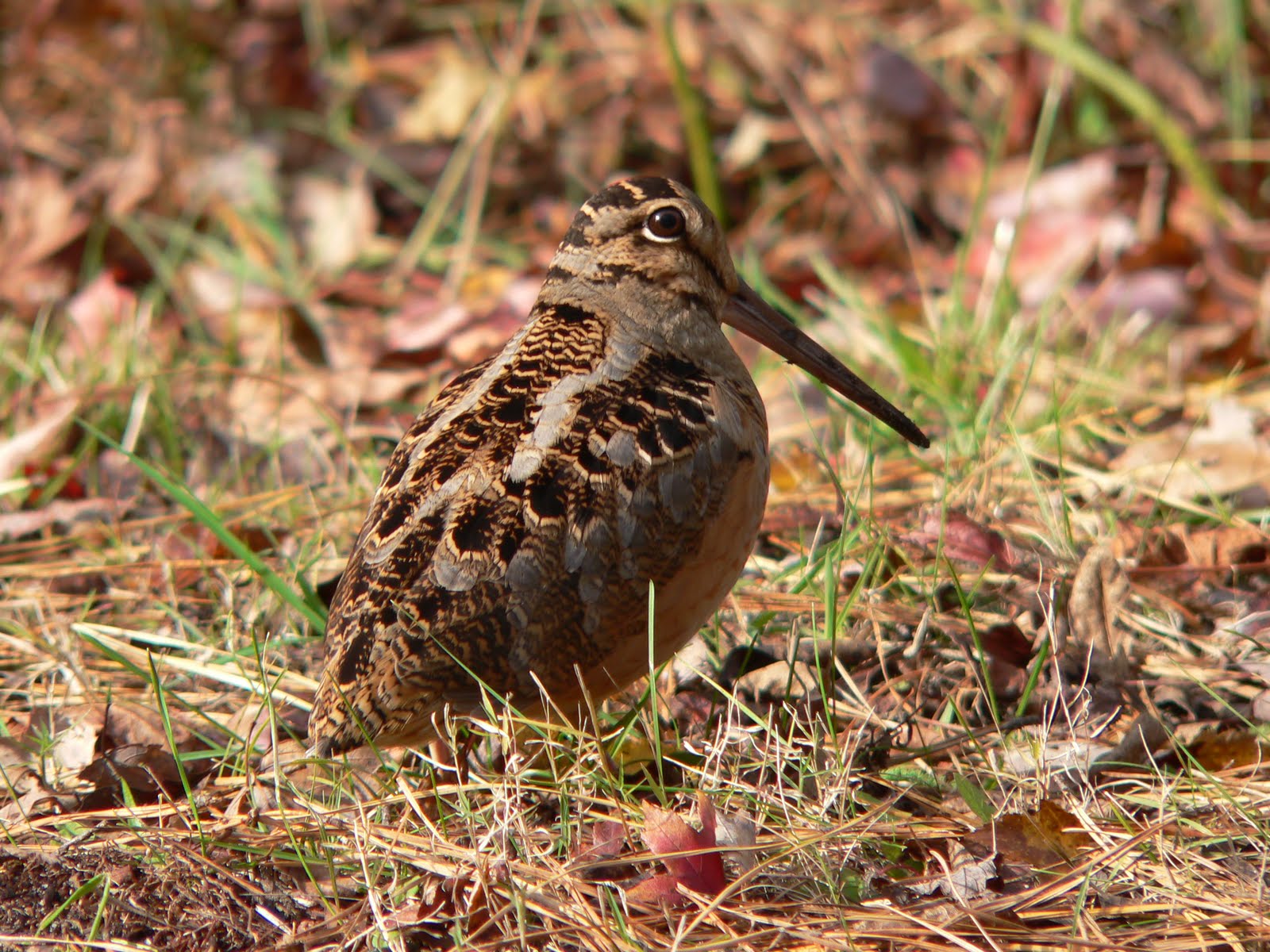
At this time of year American Woodcock can be heard performing their flight displays before sunrise and after sunset in damp, open areas in wooded habitat.
Males peent for a while, then rise into the air and begin a continuous twittering, produced by the attenuated outermost three primaries. Approaching the peak of the flight the twittering becomes intermittent, and vocal chirping begins. As the bird descends it gives forth a continuous flow of chirps and twitters before silently falling to the ground at the end, often to the same spot where the display began.
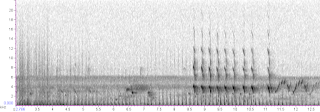
This recording begins with a bird at the height of a display flight, and ends with a second, complete, flight display, with peents in between. At 77s a rattle can be heard, an aggressive call given by interacting males.
Baird's Sparrow singing shortly after dawn at the Lostwood National Wildlife Refuge, in a short-grass prairie habitat. Other birds heard in the chorus include Marbled Godwit, Western Meadowlark, Savannah Sparrow, Clay-colored Sparrow, American Coot, Bobolink and Sora. (late May)
It is well-known that Red-eyed Vireos incorporate notes of other species into their songs. This bird included a Carolina Wren-like phrase and an Eastern Wood-Pewee-like call in its repertoire. (July, PA).
Most songbirds learn their songs, initially babbling, then stringing together incomplete or imperfect song phrases (plastic song), before finally crystallizing their song.
This young Carolina Wren is singing an assortment of songs, with a jeer call at 10s (July, NJ). Successive song phrases are all different, whereas adult males sing the same song many times before switching to a new one.
Male Eastern and Spotted Towhees have a so-called complex quiet song that can be heard during the breeding season after interactions with another towhee or even a bird of another species (BNA). The complex quiet song is a collection of call notes, and so is in a way similar to the rambling song of the White-eyed Vireo.
These recordings are of a male that had just had a confrontation with another male. There are at least nine different calls, including the commonly heard chewink and lisping see, but also several different chip-like calls, a low, distant-sounding caw, and a high buzz. The calls went on for more than twelve minutes.
Red-winged Blackbird, two males counter-singing (Apr, NJ). Each male has a repertoire of up to nine songs.
Red-winged Blackbird with the vaguely similar Seaside Sparrow singing (Apr, NJ).
Seaside Sparrow to left
Female Red-winged Blackbirds have calls that have been interpreted as representing song. Here the hard tup calls are by males, all other vocalizations by females. (June, PA).
Here the female vocalizations coincide with the male song, and when vocalizing the female fluffed up its feathers similar to a singing male, further evidence that this is a female song (May, PA).
Males making a female-like vocalization (July, PA).
Rusty Blackbirds have two song types, a squeaky wheel type and another that is gurgling. Both sexes sing (male, Apr, NJ).
(April, NJ)
In this version, the bird adds chips in between the song phrases (April, PA)
A hoarse-sounding song by a hidden bird that I'm fairly sure was a female (April, PA).
In the spring Rusty Blackbirds move north in noisy flocks of singing birds, often with Red-winged Blackbirds mixed in. This flock of about twenty birds was in a wooded area with standing water in April, again in SW NJ. Hopefully we'll continue to hear this sound, as Rusty Blackbirds are dramatically declining.
About 50 birds in a tree (April, PA).
The Common Grackle "song" is call-like and can have a squeaky component, resembling the Rusty Blackbird song. Each individual (both sexes sing) has only one song. In the following example, two birds appeared to be duetting (Mar, PA). At least one (the other was hidden) performed the ruffed out display as it sang.
Another example (Apr, NJ).
The song is often two-parted, with a whistle following the initial harsh phrase. The bird ruffles its neck feathers for the first part, then points its bill down and cocks its tail up for the whistle (Mar, PA).
In this example, some of the songs have the whistle, some don't (with check and trr calls, Mar, PA).
Boat-tailed Grackle singing at dawn. Each bird has a syllable repertoire of about 10 (Apr, NJ).
Song with wing-fluttering.
Displaying males make a low fluttering sound in short flights (Feb,FL).
time scale reduced
The Brown-headed Cowbird song is a bubbly note at the start followed by a whistle. Each male has a small repertoire of several different phrases.
Lone male in tree top (May, NJ)
In this example, the lone male, singing at the top of a tree interjects a two-noted flight whistle on occasion (Apr, PA).
the flight whistle (each male has one)
Baltimore Oriole (May, PA).
(May, NJ).
(May, NJ)
The song often sounds like nothing more than a call (May, NJ).
(June,PA)
Orchard Oriole (May, VA)
(Eastern Kingbird in background, May, NJ).
Bobolink, each male has a repertoire of two, but they are often sung incompletely (June, PA).
(June, NJ)
The song is often given in flight (June, NJ)
As with many other species in this family, Bobolinks sing in noisy flocks when migrating (May, PA).
Eastern Meadowlarks have large repertoires. Singing often takes place from the tops of tall trees (June, PA).
song by a flock of wintering birds (Nov, NJ).
Western Meadowlark, each male has a reperoire of about seven songs (dawn, Mar, NE).
Birds of the World Online previously The Birds of North America Online (BNA). Comprehensive information on all aspects of life history, including audio and video. By subscription.
Birdsong by the Seasons. Donald Kroodsma, Houghton Mifflin, 2009. Another great book with CDs from Dr Kroodsma.
Flight Calls of Migratory Birds WR Evans and M O'Brien. CD-ROM www.oldbird.org. Excellent source of information on flight calls
Nature's Music, The Science of Birdsong. Peter Marler and Hans Slabbekoorn. Elsevier Academic press. 2004. A treasure trove of information, advanced but very readable (comes with CD).
Peterson Field Guide to Bird Sounds of Eastern North America. Nathan Pieplow, 2017. Highly recommended, includes almost all known vocalizations of eastern US birds, with spectrograms and detailed analysis. Excellent!
Stokes Field Guide to Bird Song, Eastern Region, by Lang Elliot. 3 CDs. Of commercial recordings, this has the most comprehensive collection of songs and calls.
The Singing Life of Birds. Donald Kroodsma, Houghton Mifflin, 2005. Terrific book (plus CD), a must read.
The Songs of Wildbirds. Lang Elliott., Houghton Mifflin, 2005. Excellent photos with high quality recordings including some rare ones such as the flight song of the Western Meadowlark.
The Sound Approach to Birding. A guide to understanding bird sound. A. van de Berg, M Constantine, M. Robb. Superb discussion of bird calls and song with 2 CDs.


 Common Yellowthroat call




+Palmyra+NJ+61910.WAV1.png)
+Palmyra+NJ+61910.WAV2.png)
+Palmyra+NJ+61910.WAV5.png)
+Palmyra+NJ+61910.WAV3.png)
+Palmyra+NJ+61910.WAV4.png)
+Palmyra+NJ+61910.WAV.png)


.wav.png)
.wav.png)


.png)