Wrens in Britain have a more powerful song than their cousins from eastern North America, and the call notes are different, even though they are considered the same species.
Addendum July 2010: They are now considered separate species, Eurasian and Winter Wren.
(Apr, Herts, England).
The song of the eastern US (Winter) Wren sounds weaker by comparison, with less frequency variation (July, ME). Most Winter Wrens in the eastern United States sing only two different songs, albeit amazingly long and complicated vocalizations (western birds, now a separate species, Pacific Wren, have a larger repertoire). (July, ME)
time scale reduced
Alarm calls are uttered rapidly in a staccato series. The bird in the foreground was a male; the nearby bird with the doubled call was presumably the female (Apr, Herts).
Another example of the doubled call (Apr, Suffolk).
Another commonly heard call, a rapid series of notes (Apr, Herts).
The eastern US Winter Wren alarm call is usually uttered in pairs, but is quite different from the above calls (Oct, PA).
Less commonly heard, a staccato alarm by a Winter Wren (Mar, PA).
For a discussion regarding the differences in calls and songs of eastern and western US Winter Wrens, including a possible species split, see Earbirding. To my ears, the calls of British Wrens are closer to those of the western US birds.
Blue Tit songs. The following are clearly songs, but as with other titmice, many vocalizations are difficult to assign to call or song.
(Mar, Herts)
(Mar, Herts)
(Mar, Herts)
Singing atdawn is persistent. At the end of this recording I believe mating occurred, with one of the birds twittering at high frequency (May, Herts).
twitter/mating call twitter, time scale reduced
Great Tit.
Coal Tit songs are similar in rhythm to the Great Tit, but have a different tone.
>
Coal Tit and Great Tit together.
Coal Tit
Great Tit
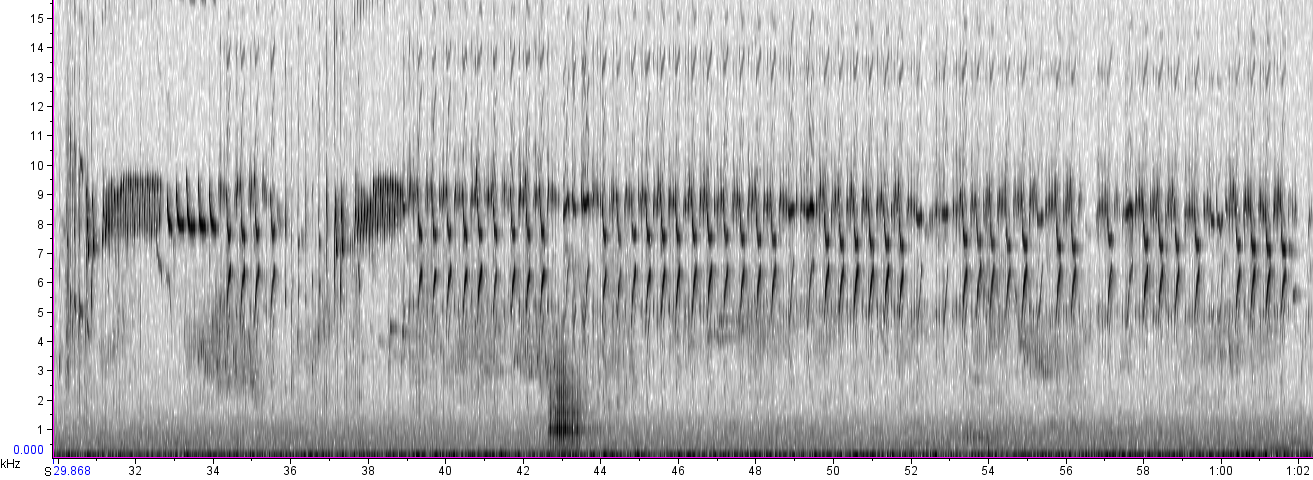
Coal Tit "courtship/copulation" song. This extended song was made at the time of intimate association with a female. Initially the birds chased around a bush with twittering, and then the male fluttered his wings rapidly and at one point mounted the female, uttering this remarkable continuous vocalization (Apr, Herts).
time scale reduced
Marsh and Willow Tits are very similar in appearance but have different vocalizations.
Marsh Tit.
Willow Tit (May, Herts).
(July, Italy)
One of the two song types of the Wood Warbler is similar to the Willow Tit (June, Suffolk).
Birds of the World Online previously The Birds of North America Online (BNA). Comprehensive information on all aspects of life history, including audio and video. By subscription.
Birdsong by the Seasons. Donald Kroodsma, Houghton Mifflin, 2009. Another great book with CDs from Dr Kroodsma.
Flight Calls of Migratory Birds WR Evans and M O'Brien. CD-ROM www.oldbird.org. Excellent source of information on flight calls
Nature's Music, The Science of Birdsong. Peter Marler and Hans Slabbekoorn. Elsevier Academic press. 2004. A treasure trove of information, advanced but very readable (comes with CD).
Peterson Field Guide to Bird Sounds of Eastern North America. Nathan Pieplow, 2017. Highly recommended, includes almost all known vocalizations of eastern US birds, with spectrograms and detailed analysis. Excellent!
Stokes Field Guide to Bird Song, Eastern Region, by Lang Elliot. 3 CDs. Of commercial recordings, this has the most comprehensive collection of songs and calls.
The Singing Life of Birds. Donald Kroodsma, Houghton Mifflin, 2005. Terrific book (plus CD), a must read.
The Songs of Wildbirds. Lang Elliott., Houghton Mifflin, 2005. Excellent photos with high quality recordings including some rare ones such as the flight song of the Western Meadowlark.
The Sound Approach to Birding. A guide to understanding bird sound. A. van de Berg, M Constantine, M. Robb. Superb discussion of bird calls and song with 2 CDs.


.wav.png) time scale reduced
time scale reduced


.mp3.png)


.wav.png)
.wav.png)
.wav.png)




.mp3.png)


.mp3.png)
.mp3.png)
.wav.png)

.wav.png)


